
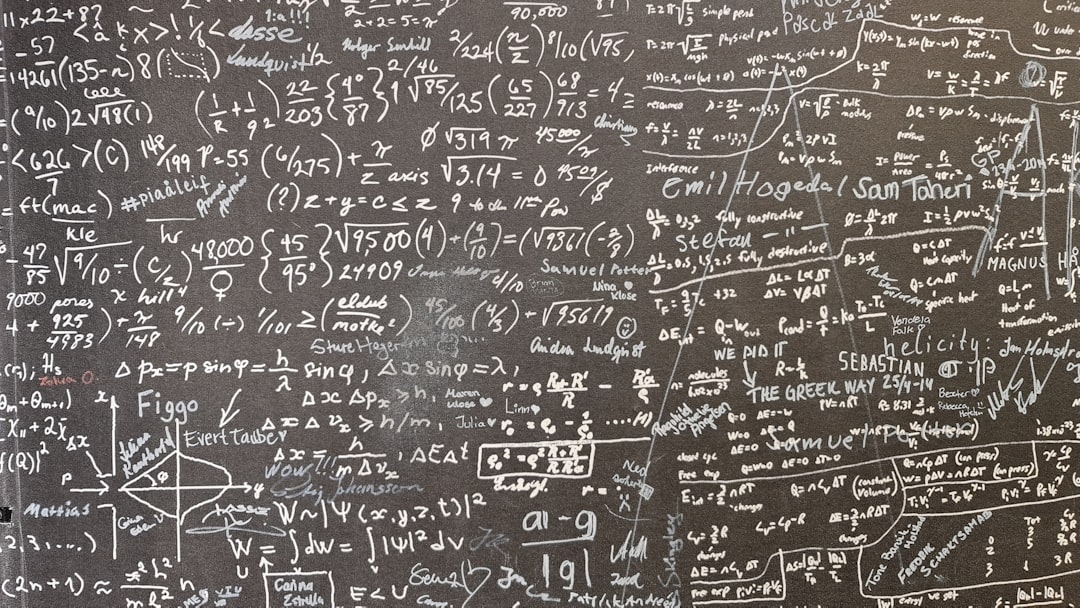
The journey to creating AI models capable of advanced mathematical reasoning is both thrilling and complex. Recently, we shared our initial proof submissions for the First Proof math challenge, which tests the ability of AI to perform research-grade logical reasoning on expert-level problems.
This challenge is designed to push the boundaries of machine reasoning, aiming to see how well an AI can handle problems that typically require deep understanding and creative insight—not just straightforward calculations.
What Is the First Proof Math Challenge?
The First Proof math challenge involves a series of complex mathematical problems that demand rigorous logical deduction, theorem formulation, and verification. It is aimed at evaluating AI models' capabilities in handling high-level abstract reasoning rather than routine computations.
Participants must submit proof attempts, which are AI-generated solutions trying to tackle these expert-level problems. This offers a unique opportunity to gauge the limits and progress of current AI reasoning models.
How Does Our AI Model Approach These Proof Attempts?
Our AI model uses multiple reasoning layers to construct potential proofs, combining pattern recognition with symbolic logic techniques. It attempts to break down the problem into smaller subproblems, validating each step to build a cohesive argument or counterexample.
Because these problems are highly complex, the model iterates through various strategies, learning from unsuccessful attempts to refine future submissions. This iterative approach resembles how human researchers refine their proofs after careful review and feedback.
Technical Terms Explained
- Proof Attempt: The AI-generated logical argument aiming to solve a mathematical problem.
- Research-grade Reasoning: High-quality, rigorous thinking reflective of scholarly work in mathematics.
- Theorem Verification: The process of checking that each step in a proof is logically sound.
When Should You Use AI Models for Mathematical Reasoning?
AI models like ours can be particularly valuable when dealing with problems that involve intricate logical structures or when exploring multiple proof paths simultaneously. They excel in:
- Generating novel insights by testing unconventional proof strategies.
- Handling large datasets of mathematical knowledge quickly.
- Automating routine verification steps to free up human researchers’ time.
However, it's critical to recognize that these models sometimes struggle with common pitfalls related to overfitting on familiar problems or misinterpreting subtle logical nuances.
Common Mistakes in AI Proof Attempts
Our experience with early submissions revealed some typical mistakes to watch out for:
- Overgeneralization: The model tries to apply a proof step too broadly, missing exceptions.
- Logical Gaps: Missing links in reasoning where assumptions are not sufficiently justified.
- Redundancy: Repeating the same reasoning paths without progress.
Recognizing these mistakes helps us improve the model's approach, much like a researcher revising their proof draft.
Is a Hybrid Approach More Effective?
Combining AI-generated proof attempts with human intuition and verification tends to yield the best results. While AI explores a broad range of possibilities quickly, humans can provide oversight for logical consistency and creativity.
This collaborative method reduces error propagation and encourages continual improvement of the AI model.
What’s Next: Implementing Your Own Proof Submission Workflow
If you’re interested in testing AI reasoning on challenging problems:
- Start by selecting a complex math problem suitable for incremental reasoning.
- Run multiple AI-generated proof attempts, logging each for evaluation.
- Analyze common failure points by comparing proofs and identifying logical gaps.
- Iterate by adjusting model parameters or guiding AI strategies towards underexplored proof paths.
This step-by-step approach mirrors our real-world efforts and can be completed within 20-30 minutes with the right tools.
Exploring AI’s potential in expert-level mathematical reasoning is a challenging but rewarding endeavor, illuminating how machine intelligence can complement human insight in problem-solving.
Technical Terms
Glossary terms mentioned in this article













Comments
Be the first to comment
Be the first to comment
Your opinions are valuable to us