
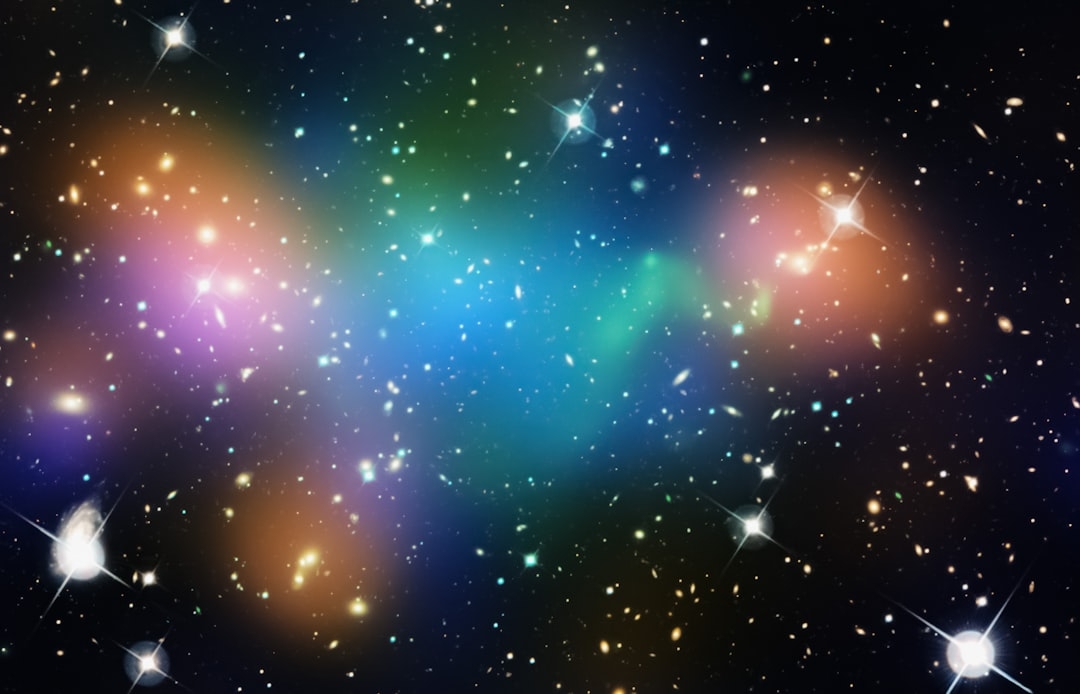
Discovering a galaxy almost entirely made of dark matter challenges our understanding of the universe’s structure. Recently, astronomers confirmed that what were once considered four distinct star clusters actually belong to one massive, nearly invisible galaxy dominated by dark matter.
This revelation is critical because it highlights the elusive nature of dark matter, a mysterious substance that does not emit light but influences the gravitational pull in space. Understanding such unusual galaxies helps scientists grasp how cosmic matter is distributed and how galaxies form and evolve.
How Did Scientists Confirm This Dark Matter Galaxy?
Initially, astronomers identified four separate star clusters scattered in a particular region of space. However, detailed observations and measurements, including stellar motion studies, indicated these clusters shared a common gravitational center.
The crucial turning point was observing how stars moved within and around these clusters. The movement patterns suggested these stars were bound together by a form of mass not visible—dark matter. This type of matter does not interact with light or electromagnetic radiation, making it invisible to telescopes but detectable through its gravitational effects.
What Is Dark Matter and Why Is It Important?
Dark matter is a fundamental concept in astrophysics. Unlike ordinary matter, it neither emits nor absorbs light, so it cannot be seen directly. Scientists confirm its presence based on gravitational effects on visible matter, radiation, and the large-scale structure of the universe. Dark matter is thought to make up about 27% of the universe, yet it remains one of the greatest mysteries in science.
In this case, the movement of stars within what was thought to be separate clusters indicates they are held together by a massive amount of dark matter. This means the galaxy's visible stars account for only a tiny fraction of its total mass.
When Should Such Discoveries Change Our Understanding?
This finding challenges the common assumption that galaxies must contain substantial visible matter to be classified as galaxies. There are galaxies where dark matter overwhelmingly dominates, but these are difficult to detect because they emit very little light.
Recognizing such galaxies pushes astronomers to refine their detection methods, focusing more on gravitational analysis rather than relying solely on visible light observations. It's a reminder that traditional methods might underestimate the size and nature of cosmic structures.
Trade-Offs in Detecting Dark Matter-Dominated Galaxies
- Visibility vs. Gravitational Influence: Objects rich in stars are easier to spot but might represent only a part of the cosmic matter.
- Complexity of Interpretation: Analyzing star motions requires sophisticated modeling, which can be resource-intensive.
- Uncertainty in Composition: Since dark matter is invisible, conclusions depend heavily on indirect evidence, increasing the need for cautious interpretation.
How Does This Impact Current Astrophysical Research?
This discovery encourages more extensive searches for similar nearly invisible galaxies, potentially altering the known census of galaxies in the universe. It also reinforces the importance of studying dark matter’s role in galaxy formation.
The presence of such a galaxy confirms that the universe is more complex than visible light reveals, urging scientists to develop multi-modal observation tools combining optical, gravitational, and other data sources.
Comparison Matrix: Visible Matter vs. Dark Matter Galaxies
| Feature | Visible Matter-Dominated Galaxy | Dark Matter-Dominated Galaxy |
|---|---|---|
| Visibility | High, easily detected through telescopes | Low, nearly invisible except gravity effects |
| Star Population | Large, bright star clusters | Sparse star presence, weak light emission |
| Mass Composition | Mostly ordinary matter | Predominantly dark matter |
| Detection Method | Optical and infrared imaging | Gravitational analysis, star velocity mapping |
| Scientific Challenges | Understanding star formation | Confirming and modeling dark matter mass |
What Is the Next Step for Astronomers?
The confirmation of this dark matter-rich galaxy encourages researchers to apply similar analysis to other ambiguous star clusters. By meticulously measuring stellar speeds and gravitational effects, they can uncover more of these hidden galaxies.
This approach challenges astronomers to refine their tools and techniques. It underscores the importance of not relying solely on visible light, which can mislead or hide critical cosmic structures.
Concrete Next Action for Enthusiasts and Students
If you're interested in exploring this topic further or replicating some of the detection logic, a practical next step involves analyzing publicly available star cluster data to look for unexpected velocity patterns that might suggest underlying dark matter presence.
Start by obtaining star velocity data from accessible databases, then plot and compare stellar movements. Look for anomalies or shared motion paths that hint at gravitational binding beyond visible matter.
Technical Terms
Glossary terms mentioned in this article












Comments
Be the first to comment
Be the first to comment
Your opinions are valuable to us