
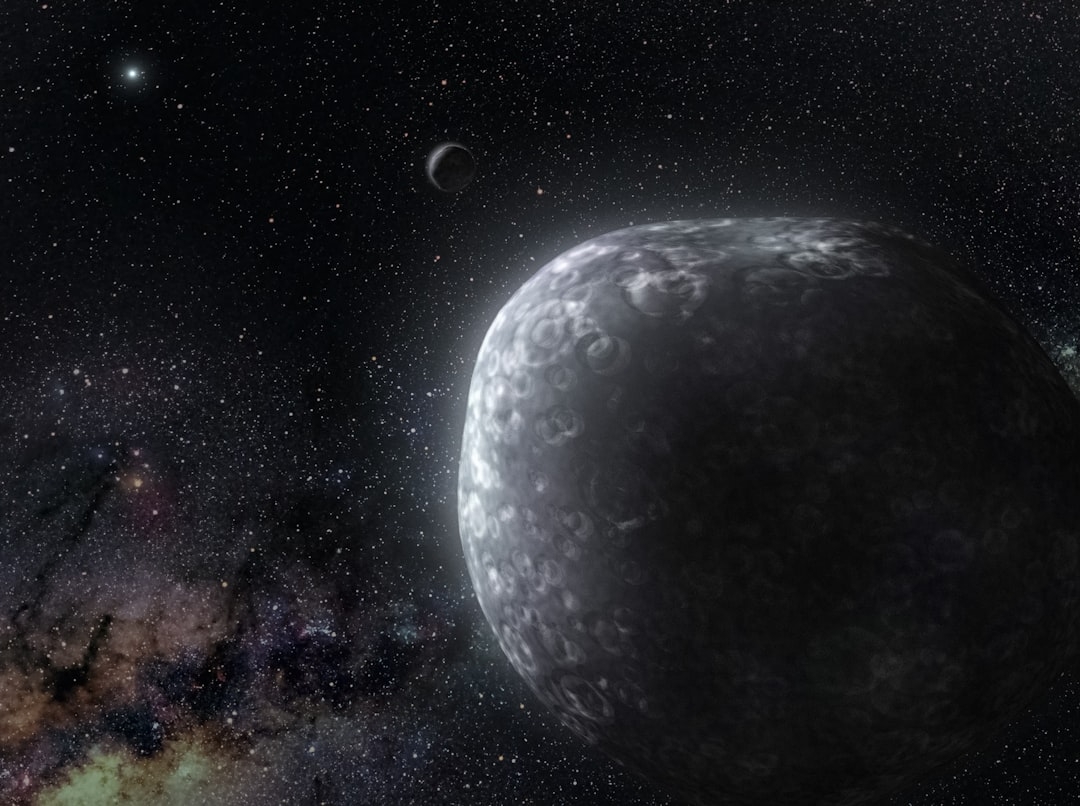
The Kuiper Belt, a vast region of icy bodies beyond Neptune, has long been a cosmic mystery. Recent advances in telescope technology are transforming how astronomers study this distant frontier, offering fresh clues about our solar system’s chaotic youth and the possibility of hidden celestial objects still undetected.
Understanding the Kuiper Belt matters because it holds keys to how our planetary neighborhood formed and evolved. It houses remnants from the solar system’s early days and potentially undiscovered planets that could reshape our models of space.
What Exactly Is the Kuiper Belt?
The Kuiper Belt is a donut-shaped collection of small icy objects orbiting the Sun beyond Neptune, roughly 30 to 55 astronomical units away (1 AU is the Earth-Sun distance). This zone includes dwarf planets like Pluto, and countless smaller objects composed mainly of frozen volatiles such as methane, ammonia, and water.
Despite being discovered over 30 years ago, the Kuiper Belt remains sparsely understood due to its distance and the faintness of its objects. It is considered a “relic reservoir,” preserving material left over from the solar system’s formation.
How Are Next-Generation Telescopes Changing Our View?
New telescopes equipped with more sensitive sensors, wider fields of view, and better resolution are now peering into the depths of the Kuiper Belt like never before. These instruments can:
- Detect smaller and more distant objects previously too faint to observe
- Map the orbital dynamics of Kuiper Belt Objects (KBOs) with high precision
- Identify unusual structures or clustering of objects that hint at gravitational influences
This influx of data is critical because it allows astronomers to spot unexpected objects or patterns that challenge established theories.
Could There Be Hidden Planets in the Kuiper Belt?
One of the most exciting prospects arising from these observations is the possibility of undiscovered planets lurking in this outer realm. Astronomers have noted oddities in the trajectories and positions of some KBOs that suggest a massive, unseen object's gravitational pull.
This hypothetical "Planet Nine" has not yet been directly observed, but its effects might be inferred through precise cataloging of KBO orbits. The ability of new telescopes to track faint movements over time is pivotal for confirming or debunking this hypothesis.
Common Misconceptions About the Kuiper Belt
Many assume the Kuiper Belt is a static, empty region or just a collection of debris drifting aimlessly. In reality, it is a dynamic zone with complex gravitational interactions shaping the distribution and behavior of countless icy worlds.
Another frequent misunderstanding is that the Kuiper Belt objects are similar to asteroids found in the asteroid belt between Mars and Jupiter. However, KBOs are largely composed of ices rather than rocky material, influencing their physical characteristics and evolution.
What Strange Structures Are Astronomers Discovering?
Recent data reveals clustering of KBOs’ orbits and unusual gaps, possibly indicating gravitational tugging by large bodies or past collisions. Some objects have orbits tilted at strange angles, which puzzles researchers about how these shapes formed.
These findings shed light on the solar system's “chaotic youth” — a period when gravitational disturbances from forming giant planets likely scattered smaller objects into their current orbits.
Why Does This Matter for Understanding Solar System Evolution?
By decoding the Kuiper Belt’s architecture, scientists can trace back the events that shaped our planetary system’s layout. This knowledge helps refine our models of planet formation and migration, which also applies to exoplanetary systems beyond our own.
Moreover, the Kuiper Belt is a reservoir of pristine material, largely unchanged for billions of years. Investigating these objects can reveal the chemical building blocks that contributed to planets and possibly the origins of life.
Common Mistakes in Studying the Kuiper Belt
Researchers sometimes over-rely on indirect evidence when proposing new planets, without concrete observational confirmation. This can lead to premature announcements and skewed public expectations.
Another pitfall involves underestimating observational biases: because distant objects are faint and difficult to detect, surveys can miss populations of KBOs, leading to incomplete or misleading conclusions.
What Next Steps Should Interested Astronomers Take?
For those involved in observational astronomy focusing on the Kuiper Belt, a practical step is to use the latest sky survey data to cross-check previously cataloged KBOs for changes in orbit or brightness, signaling new activity or unseen influences.
Monitoring minor objects over weeks or months can uncover perturbations caused by massive neighbors, sharpening the search for hidden planets.
Combining data from multiple telescopes and wavelength regimes (optical, infrared, radio) enhances detection capabilities and characterization.
What Tools Are Essential for Kuiper Belt Research?
Key tools include:
- Wide-field CCD cameras for capturing large sky areas
- Advanced image processing software to detect faint moving objects against star fields
- Orbital simulation software to model gravitational effects and predict positions
How Can Amateurs Contribute to Kuiper Belt Exploration?
With accessible software and publicly available data, amateur astronomers can participate by reporting new moving objects or monitoring brightness variations of known KBOs.
This community effort can help build comprehensive catalogs and alert professionals to targets for deeper study.
Why Is Patience Key When Studying the Kuiper Belt?
The immense distances and faintness of this region mean discoveries can be slow and require persistent observation campaigns. Rushing interpretations can lead to errors; continuous, patient data gathering and analysis are essential to teasing out the Kuiper Belt’s secrets.
Call to Action: How to Begin Mapping the Kuiper Belt in 20-30 Minutes
Start by accessing publicly available sky survey databases like Pan-STARRS or the Dark Energy Survey. Download images covering a Kuiper Belt region and use simple blinking techniques—rapidly comparing sequential images—to spot moving points of light against fixed stars.
Once identified, log the objects' coordinates and compare to existing catalogs to determine if you’ve found a known or unknown KBO candidate. This hands-on exercise provides practical experience with the challenges and excitement of outer solar system exploration.
Technical Terms
Glossary terms mentioned in this article












Comments
Be the first to comment
Be the first to comment
Your opinions are valuable to us